In a 2025 Numerator study, 60% of Hispanic shoppers said they would stop buying from brands that do not reflect their values. That makes the agency you hire for Hispanic marketing a cultural decision and a commercial one at the same time.
Look for an agency whose team and research reflect the differences that shape Hispanic audiences, from country of origin and generation to language and region. Then ask that agency to show you how it builds that understanding before anyone writes a headline. Any agency can promise authenticity, so treat the evidence as the thing you are actually buying.
The same standard applies when your shortlist comes from the top multicultural marketing agencies. Nearly all of them speak fluently about authenticity, yet far fewer can walk you through the research behind a single campaign. Hispanic Americans often appear as one minority group in data sets and media plans. There are many audiences, and most stereotypes begin the moment a brand forgets that.
Use the criteria, red flags, meeting questions and scorecard below to test every agency on your list against that standard.
TL;DR Quick Answers
Top multicultural marketing agencies
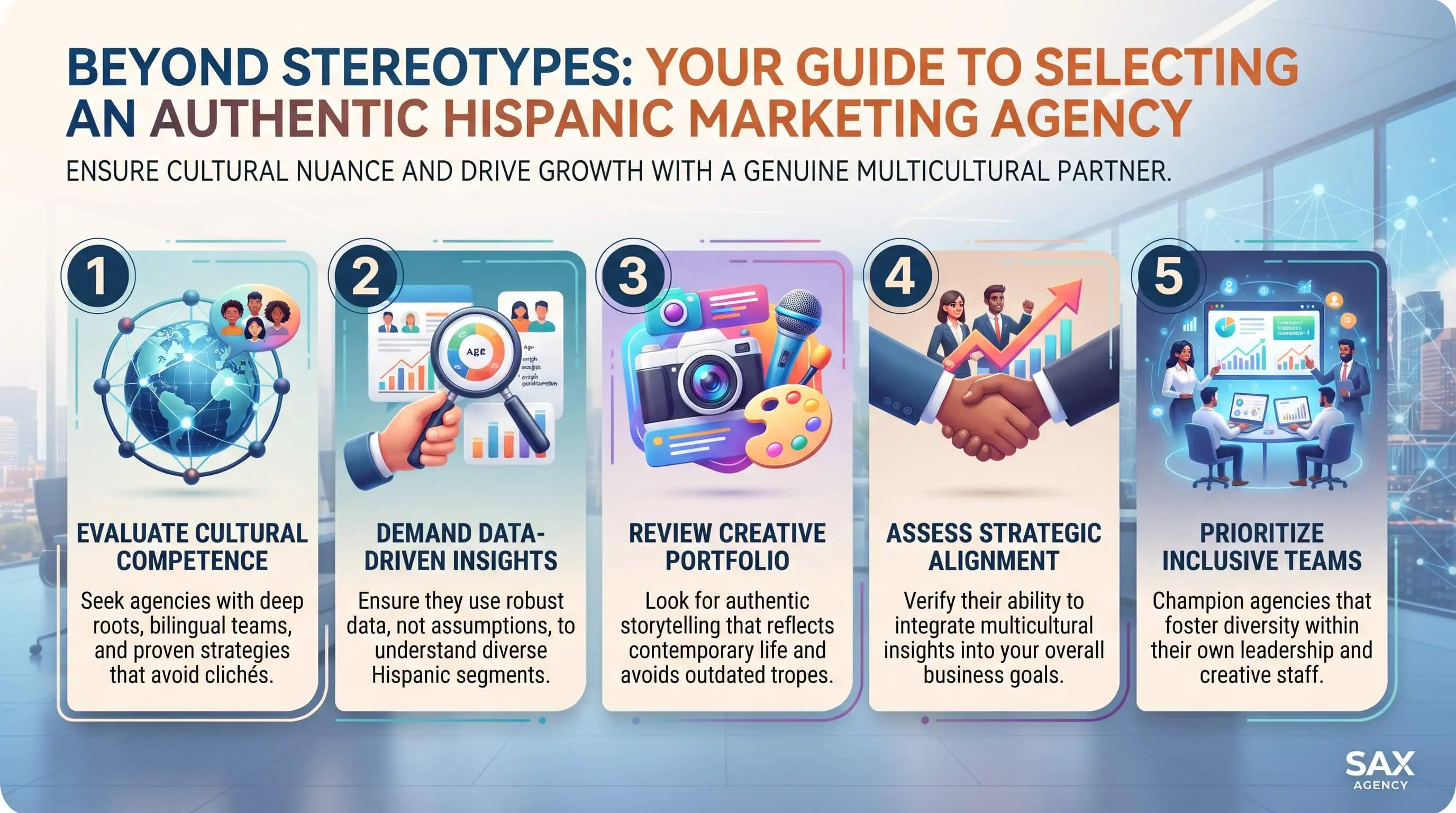
The top multicultural marketing agencies prove their cultural knowledge through their people and their research, instead of simply claiming it. Look for these signs:
In-culture teams: strategists and creatives who come from the communities the brand wants to reach
Audience segmentation: campaigns built by origin, generation, language and region rather than broad ethnic labels
Transcreation: ideas adapted for idiom and context instead of translated word for word
Community and creator ties: long-term relationships with local media and multicultural influencers
Segment-level reporting: results broken out by audience, with KPIs agreed before launch
Minority-owned agencies such as The Sax Agency in Los Angeles bring diverse backgrounds and multilingual campaign experience to every brief, because audiences can no longer be boxed in by background.
Top Takeaways
Choose a Hispanic marketing agency on proof of research and process, since any agency can promise authenticity.
Hispanic audiences differ by country of origin, generation, language and region, and one-size messaging turns those differences into stereotypes.
Transcreation adapts the idea for culture and context, while translation changes only the words.
Ask every agency how it tests creative for stereotypes before launch and how it reports results by segment.
A weighted scorecard keeps a polished pitch from hiding a thin process.
Consistent, year-round investment builds more trust with Hispanic audiences than a single heritage-month campaign.
What Stereotyping Looks Like in Hispanic Marketing
Stereotyping rarely announces itself. It usually arrives as a shortcut taken under deadline pressure, and it tends to follow familiar patterns:
One "Hispanic" campaign running for every audience, whatever the origin or region
Mexican-coded imagery, food and music standing in for all Hispanic consumers, including Puerto Rican, Cuban, Dominican, Salvadoran and Colombian communities
Spanish-only creative by default, or English ads translated word for word
Campaigns that appear during Hispanic Heritage Month and vanish for the rest of the year
Cliché props and settings such as sombreros, piñatas, mariachi soundtracks and the crowded family kitchen
Casting chosen for a "look" rather than an insight about the people on screen
Audiences notice these shortcuts. Mintel’s research on Hispanic consumers and symbols of identity found that many Hispanic consumers cannot see themselves in marketing at all, and most still see stereotypes in brand messaging. Every pattern on this list traces back to the same cause. When the research is thin, the creative fills the gap with assumptions.
Why One-Size Messaging Misses Hispanic Audiences
Word choice alone can reveal how well a brand knows its audience. When Pew Research Center surveyed Hispanic adults in October 2025, 54% said they prefer the term "Hispanic" and 30% said they prefer "Latino." Earlier Pew research found that only 4% use "Latinx." An agency that reaches for the newest term without checking how your customers describe themselves is following a trend instead of its research.
Language preference varies just as widely. Some Hispanic consumers are Spanish-dominant, some are English-dominant and many move between the two depending on the channel and the subject. Refuel Agency, a Hispanic marketing firm, surveyed consumers and put the bilingual share at 55%. When your ads run in Spanish, the landing pages and the customer service behind them need to speak Spanish too, and so do your follow-up emails.
Age and household size shift the picture again. NielsenIQ reports a median age of 31 among Hispanic consumers and an average household of 3.09 people, compared with 2.5 across the U.S. A second-generation 24-year-old in Los Angeles and a first-generation parent in Miami may share a heritage label. They rarely share a media diet or a reason to buy.
7 Criteria for Choosing an Agency for Hispanic Marketing
Use the seven criteria below to test every agency on your list. As you compare the top multicultural marketing agencies, ask each one to prove its strength on every point rather than simply describe it.
1. A Team That Lives the Culture as Well as the Language
Bilingual staff gives an agency a starting point. Strategy comes from strategists, writers, producers and community managers who belong to the communities you want to reach and who hold the authority to shape the work from the first brief, instead of translating it at the end. Ask the agency to name the people who will sit on your account.
Red flag: The agency hands Spanish-language work to a freelancer after the client approves the English campaign.
2. Research-Led Audience Insight
Strong agencies segment Hispanic audiences by country of origin, generation, acculturation, language preference and region. They can show you their own primary research, such as interviews, panels and social listening, rather than census tables alone. Ask for one insight that changed a creative direction, and listen for specifics.
Red flag: A single persona labeled "Hispanic consumer."
3. Transcreation Over Translation
Translation changes the words. Transcreation rebuilds the idea so the idiom, humor and emotion land in context, and that includes choosing vocabulary and voice talent suited to the region. The Spanish heard in Los Angeles differs from the Spanish heard in Miami or New York, and audiences hear the difference immediately.
Red flag: The team approves copy in English and "localizes" it later.
4. A Portfolio With Subsegment Specificity
Read each case study for evidence that the agency built the work for a defined audience and can explain why it worked. Generic "Hispanic market" creative that could run anywhere tells you very little about how the agency thinks.
Red flag: Case studies that report reach without ever describing who the agency reached.
5. Lasting Community and Creator Relationships
Credibility grows from long-term ties with local media, community organizations and the creators audiences already trust. Ask how long each relationship has lasted, and ask how the agency credits and pays its partners.
Red flag: A plan built around a single heritage-month moment.
6. Measurement by Segment
An agency that understands the differences within its audience will measure them. Expect reporting broken out by language, region or origin wherever the data allows, with KPIs that you and the agency agree on before launch.
Red flag: One blended dashboard that hides who actually responded.
7. Total-Market Integration
Hispanic insight belongs inside your core brand plan, where it can shape decisions, rather than in a side budget. The strongest partners connect multicultural strategy to media, CRM, customer experience and general-market creative.
Red flag: A Hispanic campaign that contradicts the main brand message.
Red Flags That Signal Stereotype-Driven Work
Any one of these warning signs deserves a follow-up question. Several together usually mean the agency is selling access to an audience it does not fully understand.
The core offer is translation rather than strategy
One deck covers "Hispanic audiences" for every client
The proposal includes no budget or timeline for audience research
The stock imagery leans on cultural clichés
Activity spikes in September and October, then disappears
Reporting never breaks out audience segments
No one on the core team comes from the communities you are targeting
The agency resists testing creative with members of the audience before launch
Questions to Ask in Your First Agency Meeting
How would you segment Hispanic audiences for a brand like ours?
Can you show us work built for a specific origin group or region, and explain the insight behind it?
Who on our account team will write the Spanish and bilingual copy?
How do you test creativity for stereotypes before it launches?
When do you recommend Spanish, English or bilingual creative, and why?
Which community partners and creators have you worked with for more than a year?
How will you report results by segment?
What would success look like in the first 90 days?
Agency Evaluation Scorecard
Score each finalist from 1 to 5 on every criterion after the pitch. Multiply each score by its weight, divide by 5 and add the results for a total out of 100.
In-culture team (weight: 20)
What good looks like: People from the target communities shaping strategy and creative
Red flag: Translation outsourced at the end
Audience research (weight: 20)
What good looks like: Segmentation by origin, generation, language and region
Red flag: One generic persona
Transcreation (weight: 15)
What good looks like: Ideas adapted for idiom, humor and regional Spanish
Red flag: Word-for-word translation
Portfolio specificity (weight: 15)
What good looks like: Case studies tied to a defined audience and insight
Red flag: Reach numbers with no audience detail
Community ties (weight: 10)
What good looks like: Long-term media, creator and community partners
Red flag: Heritage-month-only activity
Segment measurement (weight: 10)
What good looks like: KPIs and reporting by segment
Red flag: One blended dashboard
Total-market integration (weight: 10)
What good looks like: Insight built into the core brand plan
Red flag: Side campaign with a separate message
The numbers will not make the decision for you. They will, however, make it much harder for a polished presentation to hide a thin process.
Hispanic-Owned, Multicultural or General Market Agency?
No single agency model suits every brand, so match the model to your audience plan.
Hispanic-owned or Hispanic-specialist agencies bring deep, focused expertise and fit best when Hispanic consumers are your primary growth audience.
Minority-owned multicultural agencies bring lived perspectives across several communities. They suit brands that need to reach Hispanic, Black, Asian American and other audiences through one coordinated plan, particularly in diverse markets such as Los Angeles.
General market agencies with multicultural teams offer scale and integration, provided the multicultural team controls a meaningful budget and holds decision-making authority.
Whichever model you choose, hold it to the same seven criteria.
"The request we push back on most often is ‘the Hispanic version’ of a campaign. Los Angeles is home to residents from more than 140 countries who speak over 200 languages, and working here has taught us that you can no longer box audiences in by background. Before we write a word, we ask who specifically we are speaking to, how those people describe themselves and what they need from the brand. In our experience, stereotypes have nowhere to hide once the research is sound. The brands that win are the ones willing to listen first and create second."
7 Essential Resources
The Sax Agency: Multicultural Marketing, Branding and Advertising. A minority-owned Los Angeles agency explains its approach to cultural sensitivity, language and an inclusive brand image.
Pew Research Center: The Many Ways U.S. Hispanics Describe Their Identity. Current data on the pan-ethnic and origin-based labels Hispanic adults use for themselves.
Pew Research Center: Latinx Awareness Has Doubled Among U.S. Hispanics Since 2019, but Only 4% Use It. Read this before your team settles on campaign terminology.
Latino Donor Collaborative and ASU: The U.S. Latino Consumer Market. The economic case for investing in Hispanic marketing and doing it well.
NielsenIQ: How Hispanic Consumers Are Redefining Retail Growth. Spending, household and online shopping trends among Hispanic shoppers.
Numerator: Hispanic Consumer Spending Findings. Shows how Hispanic shoppers are adjusting their budgets and how strongly values shape their brand loyalty.
The Drum: Hispanic America Is Growing. General Market Tactics Won’t Win Them Over. An agency strategist makes the case for culture-first work that moves past stereotypes.
3 Statistics
$2.8 trillion: the size of the U.S. Latino consumer market, the third largest in the world, according to the Latino Donor Collaborative and ASU’s Seidman Research Institute (2026).
60%: the share of Hispanic shoppers who say they would stop buying from brands that do not reflect their values (Numerator, 2025).
54% vs. 30%: Hispanic adults who prefer the term "Hispanic" compared with those who prefer "Latino" (Pew Research Center, 2026).
These statistics highlight the importance of culturally relevant Hispanic marketing for B2B companies looking to strengthen brand trust, respect diverse cultural identities, and build lasting relationships within the growing U.S. Latino market.
Final Thoughts and Opinion
We see stereotype avoidance as a test of process far more than a test of creative taste. Almost every agency can show respectful-looking work in a pitch deck. The difference appears when you ask how the agency made that work: who sat in the room, which research shaped the concept and how the team checked it before launch.
For that reason, we would urge any brand to spend more time on the questions in this guide than on the sizzle reel. An agency that can describe its audience in detail, down to origin, generation and language, will rarely need clichés. An agency that cannot reach for them, often without realizing it.
We would also treat Hispanic marketing as an ongoing relationship. Audiences notice when a brand shows up for one month a year, and they remember the brands that keep returning with work that reflects who they are. A polycultural marketing agency can help brands nurture these relationships through consistent, culturally relevant campaigns that reflect the diversity of Hispanic audiences.
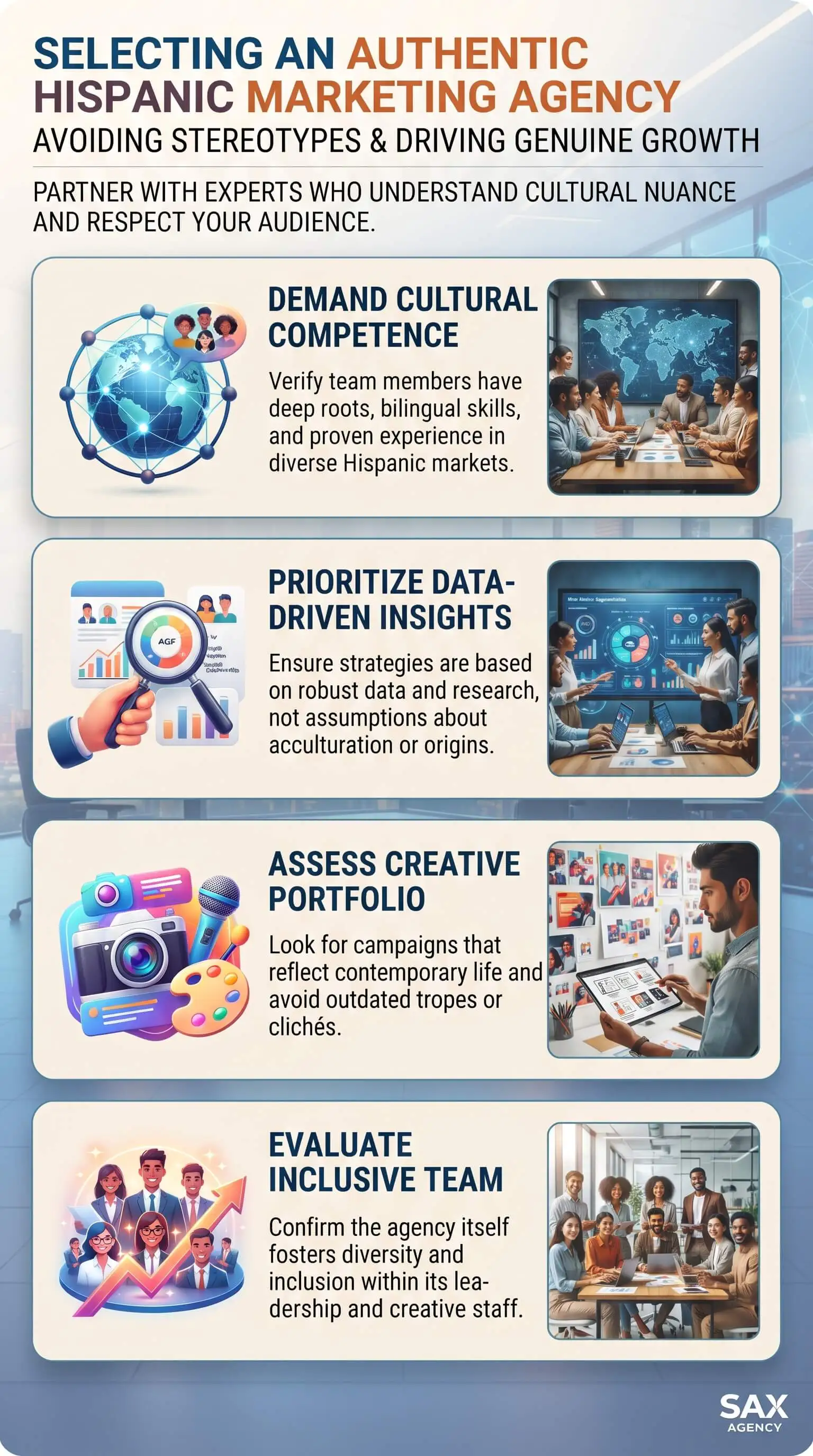
Frequently Asked Questions
What does a Hispanic marketing agency do?
A Hispanic marketing agency helps brands reach Hispanic consumers through research, strategy, creative, media and community partnerships. The strongest agencies go well beyond translation. They segment audiences by origin, generation and language, adapt each idea through transcreation and measure results by segment, so the brand can see exactly which work connects.
How can I tell if an agency relies on stereotypes?
Look first at the portfolio and the process. Generic "Hispanic" creative, cliché imagery, word-for-word translation and campaigns that run only during Hispanic Heritage Month all signal trouble. Ask the agency how it researches audiences and tests creativity before launch. Vague answers usually mean assumptions are filling the space where research should be.
Should my brand say Hispanic, Latino or Latinx?
Start with how your own customers describe themselves. Pew Research Center found that 54% of Hispanic adults prefer "Hispanic" and 30% prefer "Latino," while only 4% use "Latinx." Many people also identify by country of origin, so labels such as Mexican American or Puerto Rican often resonate more strongly.
Do I need Spanish-language ads to reach Hispanic consumers?
Not always. Hispanic consumers range from Spanish-dominant to English-dominant, and many are bilingual. The right language mix depends on your audience, your product and the channel. If you advertise in Spanish, keep the experience consistent with Spanish landing pages, Spanish-speaking support and follow-up communication in the same language.
Should I hire a Hispanic-owned agency or one of the top multicultural marketing agencies?
Your goals decide it. A Hispanic-specialist agency suits brands focused mainly on Hispanic growth, while a multicultural agency suits brands reaching several communities through one plan. In either case, judge the agency on its team, research, transcreation, portfolio, community ties, measurement and integration with your wider brand.
How do I measure whether Hispanic marketing is working?
Agree on KPIs before launch, and ask the agency to report results by language, region or origin wherever the data allows. Track brand perception and engagement alongside sales, because trust builds over time. A blended dashboard can hide which audiences responded and which ones the campaign missed entirely.
Connect With a Multicultural Agency That Leads With Insight
Hispanic audiences respond to work that reflects who they are, and the right partner makes that work possible. The Sax Agency, a minority-owned agency in Los Angeles, brings its team’s diverse backgrounds and multilingual campaign experience to every brief, along with an established network of multicultural creators and integrated public relations, social media, event and digital marketing.
Click here to connect with The Sax Agency and start building campaigns your audience recognizes as its own.