Picture a business owner who signed a revocable trust eight years ago and went straight back to running her company. Since then she's refinanced the house and opened two brokerage accounts. Last spring she bought a lake place in Minnesota. None of it made it into the trust, so the plan that reads so well on paper holds almost nothing.
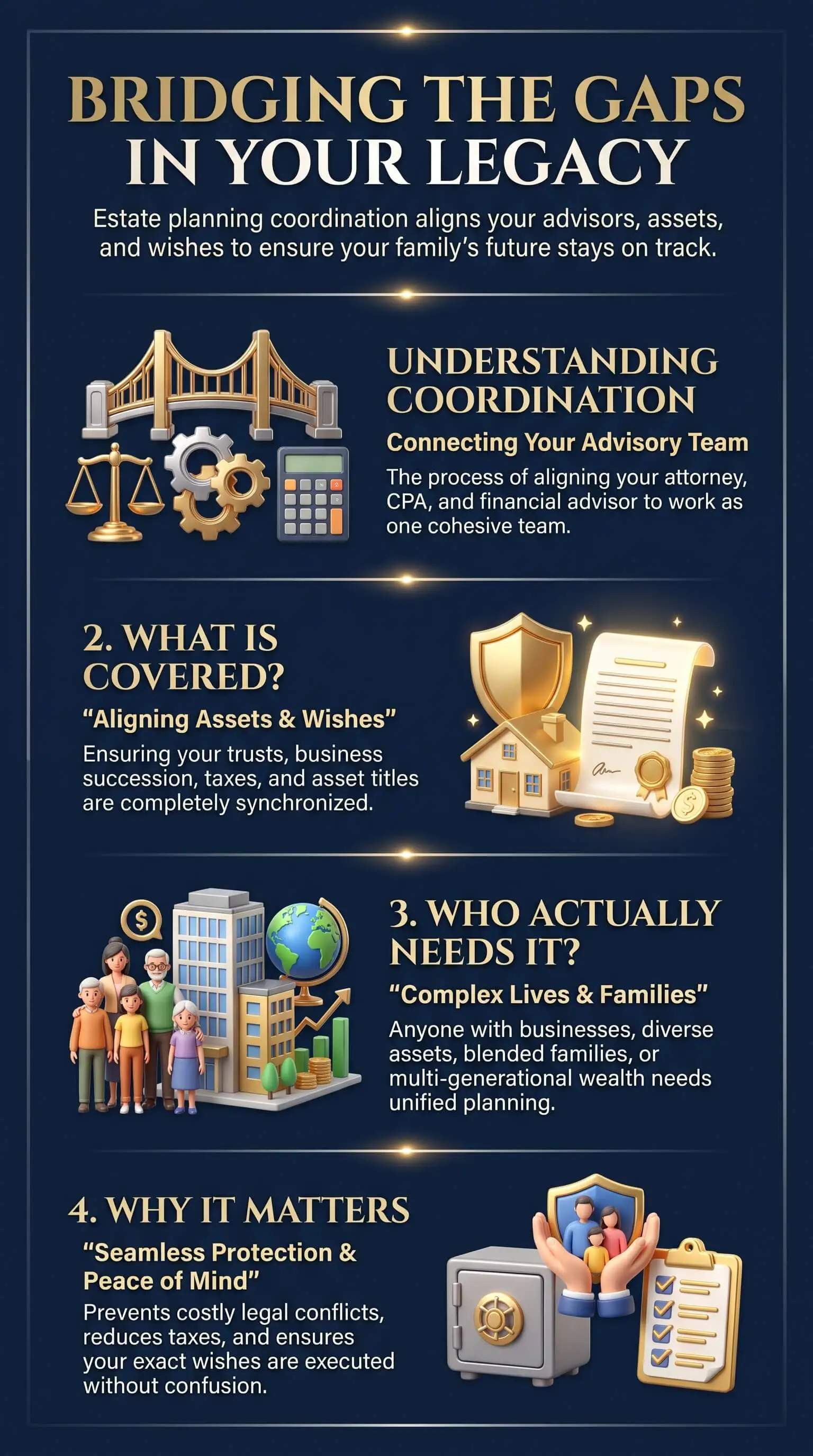
That gap between the plan on paper and the plan in practice is where estate planning coordination lives. It's the ongoing work of checking that what your documents say matches how your assets are actually titled, funded, and designated, with your attorney, CPA, and advisors working from one plan. Families who want estate planning coordination that turns documents into action usually aren't asking for new documents. They want the ones they already paid for to work.
We see some version of her story in most families we meet. Their attorney did good work, and so did their CPA. What nobody did was own the follow-through after everyone signed.
That follow-through gets far less attention than drafting, yet it decides whether the plan works, because a trust only controls the assets it actually holds.
TL;DR Quick Answers
estate planning coordination
Estate planning coordination turns signed documents into a working plan. Estate planning sets out how assets pass to the next generation, and coordination makes sure trusts are funded, titles and beneficiary forms match, and your attorney, CPA, and advisors stay aligned as life changes.
Starts once you've signed the documents, not before.
Covers trust funding, titling, beneficiaries, and records.
Works alongside your attorney and CPA rather than replacing them.
Fits families with trusts, entities, multi-state property, or a family business.
Runs on an annual review plus a check after major life events.
Top Takeaways
Estate planning coordination makes sure your documents match how assets are actually titled, funded, and designated.
The mistakes we see most are unfunded trusts, outdated beneficiary forms, and assets that drift out of the plan.
Coordination works alongside your attorney and CPA and never replaces them.
Complexity, more than net worth, decides who needs it.
An annual review, plus a check after major life events, keeps the plan execution-ready.
What Estate Planning Coordination Actually Covers
Coordination picks up where drafting stops. In practice, that covers:
Trust funding: moving the right assets into the trust and confirming they stay there.
Titling and deeds: keeping real estate, accounts, and business interests owned the way the plan expects.
Beneficiary designations: reviewing retirement accounts, life insurance, and transfer-on-death forms so they agree with the plan.
Entity alignment: making sure LLCs, partnerships, and operating companies fit the estate strategy.
Organized records: one place where documents, account lists, and key contacts live.
Plan reviews: a regular rhythm with your attorney and CPA, plus updates after big life events.
Family communication: helping heirs understand the plan before they inherit it.
Coordination doesn't replace your estate planning attorney or your CPA. Your attorney still drafts the documents and gives legal advice, and your CPA still models the tax picture. The coordinator owns implementation and follow-through, with clear ownership so nothing falls between them.
Plan on Paper vs. Plan in Practice
Primary focus: On paper, the attorney drafts the documents and the work stops. In practice, someone implements them and keeps them current.
Trust funding: On paper, the family funds the trust once, if at all. In practice, a coordinator verifies and tracks funding over time.
Titling: On paper, titles drift every time an asset changes. In practice, someone keeps them aligned with the plan.
Beneficiaries: On paper, designations fall out of date across accounts. In practice, a coordinator checks them for consistency.
Family experience: On paper, families scramble at life events. In practice, the plan stays proactive, organized, and execution-ready.
7 Estate Planning Coordination Mistakes That Leave Families Unprepared
These are the gaps we run into most often. Each one stays quiet until the family needs the plan, and each one can be fixed well before then.
1. Signing the Trust but Never Funding It
A revocable trust only controls the assets titled in its name. If the house, the brokerage account, or the business interest never moves in, those assets may still go through probate. The fix is a funding checklist with an owner and a completion date, then a check after every new account or property.
2. Letting Beneficiary Designations Override the Plan
Retirement accounts and life insurance pass by beneficiary form, not by your will. An old form naming a former spouse, or a single child, can quietly rewrite your intentions. Review every designation against the plan at least once a year and after any marriage, divorce, birth, or death.
3. Retitling Nothing After a Move, Refinance, or New Account
Refinancing can pull a home out of a trust without anyone noticing, and a new account opened online usually defaults to individual ownership. Property in a second state can mean a second probate. So every time an asset changes, someone should ask whether it's titled the way the plan expects.
4. Treating the Estate Plan as a One-Time Project
Signing the documents starts the work rather than finishing it. Families grow and businesses get sold, and tax law has a way of moving every few years. Most families do well with an annual review, plus an extra check after any major life event or transaction.
5. Letting Advisors Work in Silos
Your attorney, CPA, and investment advisor may each make a sound call that still conflicts with the others. A gift strategy can collide with an investment plan, or a tax move can quietly undercut a trust. We cover this pattern in more depth in What Does Integrated Wealth Management Mean in a Multi-Family Office? The fix is one accountable owner who keeps every recommendation on the same page.
6. Planning Around Old Estate Tax Rules
The federal estate and gift tax exemption is $15 million per person in 2026, and $30 million for a married couple. Plans built to dodge a much lower exemption may now carry trusts and steps the family no longer needs, while missing what matters more today: income tax basis, state estate taxes, probate, and continuity. Ask your attorney and CPA whether the plan still fits current law.
7. Leaving Heirs Out of the Conversation
A plan the next generation doesn't understand is fragile. Heirs who learn the details only after a death tend to make rushed decisions, and sometimes they argue. When the family talks it through before anything changes hands, both the assets and the relationships hold up better.
Who Actually Needs Estate Planning Coordination?
Families need estate planning coordination when their complexity, not just their net worth, outgrows what one advisor can track. You're probably a fit if several of these sound familiar:
You have more than one trust, or trusts plus operating entities.
You own real estate in more than one state.
You own a family business or a concentrated stock position.
You recently sold a business, received an inheritance, married, divorced, or moved.
Your adult children will inherit real responsibility, not just money.
Your plan hasn't been reviewed in three years or more.
If your estate is simple, with a few accounts and current beneficiary forms, a periodic check-in with your attorney may be enough for now. Coordination earns its keep when the moving parts multiply. Business owners often notice this first, much the way a growing company outgrows its bookkeeper and starts looking at trusted accounting services for small businesses.
How Estate Planning Coordination Works in Practice
Legacy Bridge Private Family Offices, a registered investment adviser in West Des Moines, Iowa, runs this work as four repeating steps. In one published case study, the firm coordinated a family's advisors and helped lead the family conversations needed to update a complex estate plan, saving the family more than $3 million in taxes across generations.
Inventory and review. Map every entity, account, policy, title, and document the family has.
Coordinate the professionals. Bring the attorney, CPA, and advisors to the same priorities.
Implement and verify. Track trust funding, titling, and beneficiary updates until each is complete.
Maintain and refine. Keep records current and adjust as assets and family life change.

"In our experience, the documents are rarely the weak spot. The weak spot is what happens after everyone signs. We've opened trusts that were signed years earlier and still held almost nothing, and we've found beneficiary forms pointing one direction while the will pointed another. None of that shows up until the family needs the plan most. The work that fixes it isn't glamorous. Someone has to check the titles, chase down the forms, and keep the attorney, the CPA, and the family on the same page year after year. That's what turns intent into something heirs can actually rely on."
Essential Resources
These are the sources we would hand any family taking a hard look at whether their plan is truly in place.
1. Holland & Knight and ACTEC: Funding Your Revocable Trust
A trusts and estates attorney explains what trust funding means and why assets left outside the trust can end up in probate or tangled in disputes.
2. Mercer Advisors: Connecting the Dots on Your Estate Plan
Mercer Advisors shows how beneficiary designations can take precedence over a will and why titling and beneficiary choices deserve regular review.
Source: https://www.merceradvisors.com/trust-estate/connecting-the-dots-on-your-estate-plan/
3. Wiss: The Quarterback Approach to Family Office Estate and Wealth Planning
This March 2026 piece describes how separate advisors can each make reasonable decisions that still conflict, and how a coordinator keeps them aligned.
Source: https://wiss.com/the-quarterback-approach-family-office-estate-wealth-planning/
4. Morgan Lewis: 2026 Gift and Estate Tax Exemption Amounts
Morgan Lewis summarizes the $15 million per-person exemption for 2026, its inflation indexing, and the $19,000 annual gift exclusion.
5. IRS: Estate and Gift Taxes
The IRS's own overview of estate and gift tax rules, exemptions, and filing, with links to forms and guidance for deceased taxpayers.
Source: https://www.irs.gov/businesses/small-businesses-self-employed/estate-and-gift-taxes
6. Trust & Will: 2026 Estate Planning Report
A survey of 5,000 U.S. adults on who has a will or trust, how often they review it, and why so many people put planning off.
Source: https://trustandwill.com/learn/estate-planning-report-2026
7. Investor.gov: Investment Advisers
The SEC's investor site explains how to review an adviser's services, fees, conflicts, and disciplinary history before you share your full financial picture.
Read side by side, these sources make the case for coordination better than we could. Legal documents, tax rules, and adviser choices protect a family only when someone makes sure they work together. The same principle applies to family foundation management, where coordinated oversight helps align charitable goals with the family's broader estate plan.
Statistics
The numbers below line up with what we see in client work: good intentions are common, and follow-through is not.
1. 94% say a will matters, but only 46% have one
In a July 2026 LegalShield survey of 1,850 U.S. adults, 94% said a will is important, yet only 46% had one, and 33% had no core estate documents at all.
Intent rarely turns into action on its own. Someone has to own the follow-through, and that is exactly what coordination provides.
2. About 21% of plan holders rarely or never review their documents
Trust & Will's 2026 report, based on 5,000 U.S. adults surveyed in early 2026, found about 21% of will and trust holders rarely or never review their documents, and 14% have never updated them.
Plans drift every time a family opens an account or refinances a home. An unreviewed plan is often an unfunded or misaligned one.
Source: https://trustandwill.com/learn/estate-planning-report-2026
3. The federal estate tax exemption is $15 million per person in 2026
The 2026 federal estate and gift tax exemption is $15 million per individual, or $30 million for a married couple, and it is indexed to inflation going forward, according to Morgan Lewis.
Fewer families now owe federal estate tax, so the work shifts toward probate avoidance, income tax basis, state taxes, and family continuity. That is coordination work more than drafting work.
Estate planning coordination helps families turn financial intentions into action by keeping wills, trusts, beneficiary designations, and tax strategies aligned. With many Americans lacking essential estate documents or failing to review existing plans, ongoing coordination becomes increasingly important. Just as a marketing company coordinates different strategies toward a shared goal, estate planning coordination brings attorneys, financial advisors, and tax professionals together to protect family assets, minimize potential complications, and support long-term wealth preservation.
Final Thoughts and Opinion
Most estate plans we see don't fail because the attorney got something wrong. They fail because nobody owned the work after the signing, so trusts sit half-empty while beneficiary forms quietly go stale.
Coordination is the fix, and it's less exotic than it sounds. Plenty of business owners already bring in fractional CFO support because someone has to tie the numbers to the strategy. An estate plan needs the same kind of owner.
What Coordination Delivers
Clear ownership of every open item
An attorney, CPA, and advisors working from one plan
Trust funding, titles, and beneficiaries that stay current
Less paperwork and fewer last-minute scrambles for the family
What We See When It Works
Trusts hold what they were designed to hold.
Beneficiary forms and they will finally agree.
Heirs understand the plan before they inherit it.
A business sale or a move feels planned instead of rushed.
Having an estate plan matters far less than knowing someone is making sure it still works.
Frequently Asked Questions
Q: What is estate planning coordination?
A: Estate planning coordination is the ongoing work of making sure your estate plan is actually implemented. It confirms that trusts are funded, assets are titled correctly, and beneficiary designations match the plan, with your attorney, CPA, and advisors working from the same page.
Q: What are the most common estate planning coordination mistakes?
A: The most common are signing a trust but never funding it, letting old beneficiary forms override the plan, failing to retitle assets after a move or refinance, treating the plan as a one-time project, and keeping heirs in the dark.
Q: Does estate planning coordination replace my estate planning attorney?
A: No. Your attorney still drafts documents and gives legal advice, and your CPA still handles tax planning. A coordinator works alongside them, drives implementation, and tracks each open item to completion.
Q: What does it mean to fund a trust?
A: Funding a trust means moving assets into the trust's name, such as retitling a home or brokerage account. A trust only controls what it holds, so unfunded assets may still pass through probate.
Q: How often should an estate plan be reviewed?
A: Most families benefit from an annual review, plus updates after major life events like a marriage, divorce, birth, death, move, business sale, or change in tax law.
Q: Who needs estate planning coordination?
A: Families with real complexity: multiple trusts or entities, property in several states, a family business, a recent sale or inheritance, or heirs who will take on meaningful responsibility. A simple estate may only need periodic attorney check-ins. For families managing more complex financial and estate planning needs, family office services can provide the coordination and ongoing oversight needed to keep everything aligned.
Next Steps
If your estate plan has been sitting in a drawer, start by checking whether it still matches your life.
Gather your documents. Pull your will, trusts, powers of attorney, and the most recent account statements into one place.
List every advisor. Write down your attorney, CPA, investment advisor, trustee, and insurance agent, and note who owns what.
Check the gaps. Compare trust funding, property titles, and beneficiary forms against what your plan says.
Talk with a coordinator. Ask a family office how it works with outside advisors, who owns each task, and how it is paid.
Your documents already hold your intentions. Coordination makes sure they hold your assets, too, with family office concierge services helping keep everything aligned.
One call, one team.