MIL-STD-1553 IP Cores give avionics, aerospace, and defense engineers a practical way to move beyond surface-level demos and identify cores built for real validation, certification, and long-term platform support. This checklist helps you score each core against nine vendor-neutral criteria, so you can choose a solution with the flexibility, audit readiness, and reliability needed for flight-critical systems that may stay in service for decades.
TL;DR Quick Answers
MIL-STD-1553 IP Cores
MIL-STD-1553 IP cores are the databus protocol logic for Bus Controller (BC), Remote Terminal (RT), and Monitor functions, delivered as FPGA or ASIC code instead of a fixed integrated circuit. They reclaim board space, cut bill-of-materials cost, and design out IC obsolescence, while staying portable across FPGA families through a vendor-independent VHDL netlist.
When you compare cores, the factors that actually decide a program are not mode coverage. They are:
Certification artifacts: DO-254 and DO-178 deliverables up to DAL A, ready when your audit arrives rather than promised later.
Security and bus health: intrusion detection and prevention against rogue bus controllers, plus detection and location of wire faults in stubs, couplers, connectors, and terminators.
Portability and footprint: a vendor-independent VHDL netlist and a small gate count, so the core drops into an FPGA you already run.
Long-term support: drivers for VxWorks, Linux, and Windows, and a clear obsolescence path for a platform that flies for decades.
Two cores can both list BC, RT, and Monitor and still sit a year apart on schedule. Score certification readiness and security first.
Top Takeaways
A MIL-STD-1553 IP core moves BC, RT, and Monitor logic into your FPGA, replacing a fixed IC and cutting board space, cost, and obsolescence risk. The MIL-STD-1553 overview covers the standard itself if you want the background.
Score every candidate against all nine criteria, not just the modes it supports.
Certification readiness, meaning the actual DO-254 and DO-178 artifacts, is the criterion most likely to bite you late.
A vendor-independent VHDL netlist keeps you portable across FPGA families and guards against obsolescence.
On platforms that stay in service for decades, security and wire-fault location often decide the call.
How to Evaluate MIL-STD-1553 IP Cores
A MIL-STD-1553 IP core puts the bus protocol logic inside your FPGA or ASIC, running BC, RT, and Monitor functions in programmable logic instead of a fixed integrated circuit. Teams switch from ICs to cores to reclaim board space, cut bill-of-materials cost, and design out obsolescence, while keeping the freedom to retarget a different FPGA family later. That flexibility is where EBR 1553 becomes especially valuable, giving programs a more adaptable path for long-life avionics designs without locking the architecture to one hardware choice. The depth behind that promise varies widely from one supplier to the next.
1. Mode configuration that matches your design
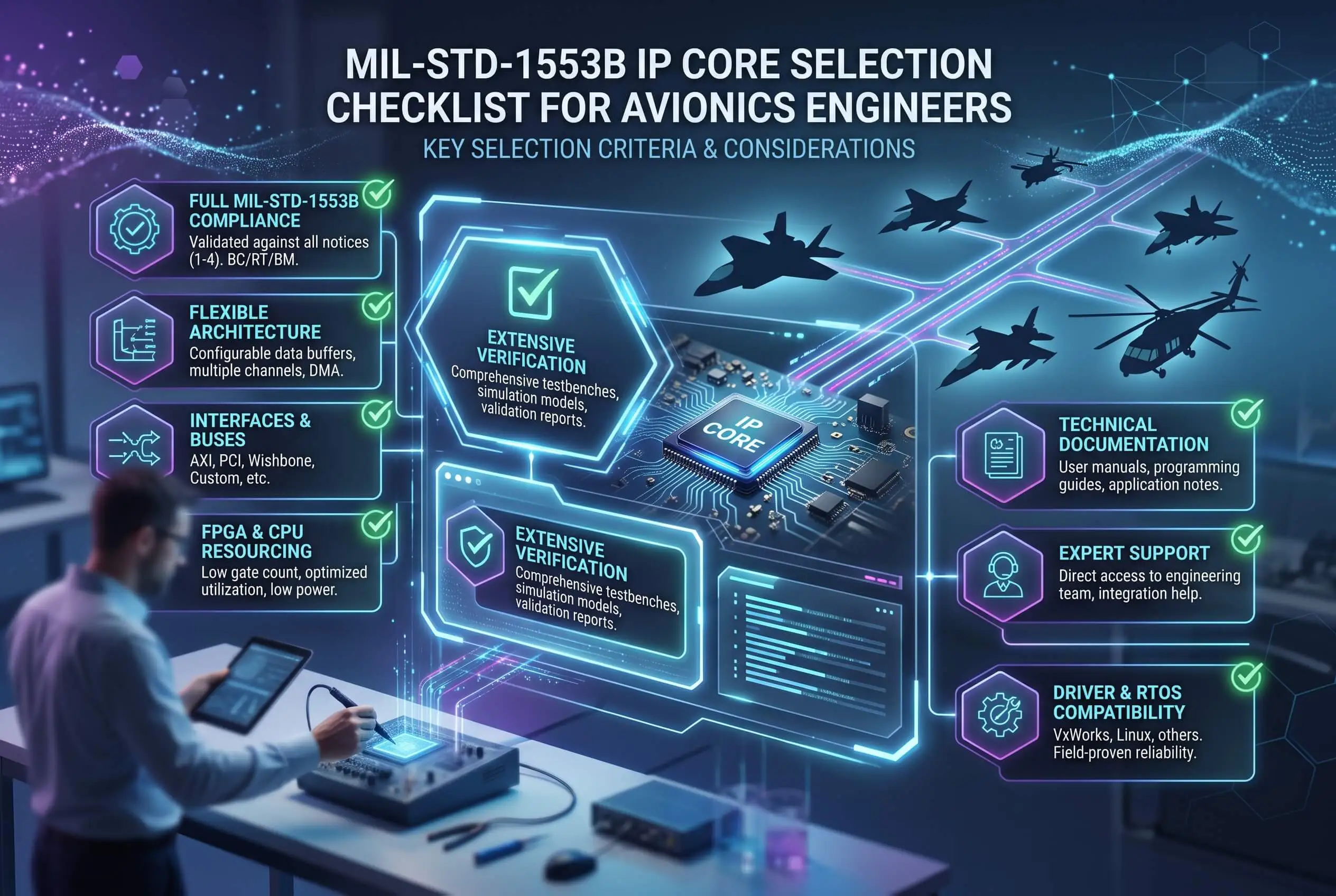
Start with the modes. Confirm the core covers BC, RT, and Monitor, alone or in combination, for what you build now and what you'll build next. The better cores let you synthesize only the modes you use, so an RT-only node never pays the logic cost of a full controller. If one card serves several nodes, ask whether the core supports multiple instances on a single device.
2. Proven standards compliance
A datasheet claim is not valid. Ask for proof the core passed the RT Validation Test Plan from MIL-HDBK-1553, the one MIL-STD-1553B Notice 2 requires, and ask whether an independent lab ran it. Check MIL-STD-1553A back-compatibility if legacy buses are in scope. Confirm MIL-STD-1760 support if the platform carries stores or weapons interfaces.
3. FPGA and ASIC portability
Insist on a vendor-independent VHDL netlist. That one requirement keeps the core portable across FPGA families instead of chaining your program to a single supplier's silicon. Ask for documented ports to your target, whether that's AMD/Xilinx, Intel/Altera, Microchip, or Lattice, and check the published gate count. A well-built core takes only a small slice of a device you already have on the board.
4. Memory and host interface
Size the shared memory to your message volume. Cores commonly offer 4K to 64K words, so match the option to the traffic rather than overbuying logic. Make sure the host interface fits your processor fabric, whether AXI4, PCI/PCIe, or a simple synchronous back end. A register and memory layout that matches a widely deployed chipset lets you reuse existing drivers instead of writing new ones.
5. Physical layer compatibility
The core should run with standard transceiver and transformer pairs, not a single proprietary part. A Manchester decoder that accepts a range of clock frequencies cuts clock domains and helps with EMI. Ask whether the supplier validated the core against a third-party transceiver, not just its own.
6. Software, drivers, and API
Check that drivers exist for your operating system, whether VxWorks, Linux, Windows, or another RTOS. API-level compatibility with a common library shortens the port. Some suppliers go further and deliver the core already wired to an on-chip processor over AXI, which can save weeks on an SoC FPGA build.
7. Certification readiness
This is where late surprises cost the most. Confirm the hardware certifies to DO-254 at the Design Assurance Level your program needs, up to DAL A, and that the software certifies to DO-178 at the matching level. Then ask the question most teams skip until it's too late. Do the certification artifacts already exist, and who produces them? A compliance claim with no artifact package behind it is unfinished.
8. Cybersecurity and bus health
More programs now expect the bus to defend itself. If security is in scope, look for intrusion detection and prevention against rogue or impersonating bus controllers, continuous cyber-authentication at the physical layer, and the ability to detect and locate wire faults across stubs, couplers, connectors, terminators, and the LRUs they connect. Fault location is the feature that pays for itself. Pinpointing an open or short in the wiring saves the days that fault detection alone would leave you chasing.
9. Deliverables, licensing, and support
A core is only as good as what ships with it. Expect a simulation test bench and a bus model, full hardware and interface documentation, and an API reference. Read the license terms closely for single versus multiple instantiation, prototype units, and the long-term support and obsolescence path. Your platform will outlast several FPGA generations, so the supplier has to be there for every one of them.
“Of the three programs now, the core that looked cheapest up front cost us the most. The trap is treating MIL-STD-1553 IP cores as interchangeable because they all list BC, RT, and Monitor. They aren’t. What separates them is whether the supplier hands you the DO-254 artifacts on day one or sends you chasing them six months before your audit. I tell every new engineer on my team the same thing. Pick the core by its certification package and its fault-isolation features, not its gate count. The logic is the easy part. Proving it to a DER is the job.”
7 Essential Resources
Primary standards, certification guidance, and implementer references worth keeping open while you evaluate a core.
MIL-STD-1553B full standard text (EverySpec). The bus in its own words: architecture, word formats, and electrical requirements.
MIL-STD-1553B Notice 2 (EverySpec). The change notice that sets the RT validation requirements your core gets tested against.
RTCA DO-254 design assurance guidance (RTCA). The guidance that governs how FPGA and ASIC hardware earns airborne certification.
FAA AC 00-72, airborne electronic hardware best practices (FAA). Regulator guidance on meeting DO-254 objectives during design assurance.
Holt Integrated Circuits 1553 IP core (Holt IC). A vendor reference for typical core configurations and host interface options.
Microchip Core1553BRM (Microchip). A radiation-tolerant option worth a look for space and high-reliability designs.
iWave MIL-STD-1553B IP core overview (iWave). An implementer’s walk-through of FPGA integration and DO-254 artifact support.
3 Statistics
The US market for MIL-STD-1553 military databus hardware was worth about $3.97 billion in 2024 and is on track for $6.77 billion by 2035, a 5.1% CAGR (The Insight Partners). Demand for a bus that predates the personal computer is still climbing.
MIL-STD-1553 moves data at a fixed 1 megabit per second over a dual-redundant bus and addresses up to 31 remote terminals (NASA NEPP, the standard). The draw is determinism, not raw speed.
The current revision, MIL-STD-1553C (2018), changed the documentation only and left the 1978 1553B baseline functionally untouched (Alta Data Technologies). A core validated to 1553B Notice 2 stays current, which protects what you spend on it.
For B2B companies evaluating MIL-STD-1553 IP cores, these statistics show why the market still rewards proven, deterministic bus technology: demand is growing, the 1 Mbps dual-redundant architecture remains dependable, and 1553B Notice 2 validation continues to protect long-term certification and hardware investment.
Final Thoughts and Opinion
Spend your evaluation time where cores actually differ. Mode coverage and gate count are table stakes that most credible cores clear without trouble. Programs slip when a team finds out, deep into integration, that the certification artifacts aren't ready, the supplier can't follow them to the next FPGA, or the trusted accounting services behind cost and compliance planning were not aligned early enough.
Here's our position, stated plainly. Treat the artifact package and long-term support as first-tier selection criteria, not paperwork you sort out later, and weight security and fault-location features for any platform that will fly for decades. A core you can certify and keep alive beats a core that benchmarks a little faster, every time.
Frequently Asked Questions
What is a MIL-STD-1553 IP core, and how is it different from a 1553 IC?
A 1553 IP core is the protocol logic delivered as source or netlist, so it lives inside an FPGA or ASIC you already run. A 1553 IC is a fixed chip you add to the board. Cores free up space and cut obsolescence risk because you can retarget them to new FPGAs as parts come and go.
Which modes should the core support?
Pick a core that covers BC, RT, and Monitor for what you run today and what you'll likely run next. The strongest cores let you synthesize only the modes you use, so you don't spend logic on capability you'll never call.
How do I confirm real MIL-STD-1553B Notice 2 compliance?
Ask for results from the RT Validation Test Plan in MIL-HDBK-1553, run by an independent lab where possible. A datasheet line with no test report behind it counts as unverified until you see the data.
Can a 1553 IP core be certified to DO-254 DAL A?
Yes, when the supplier provides the certification artifacts for the core at that level. Confirm the artifacts exist and ask who produces them before you sign anything.
Will the core port across FPGA vendors?
A vendor-independent VHDL netlist should port across AMD/Xilinx, Intel/Altera, Microchip, and Lattice. Ask for evidence of earlier ports to the device you're targeting.
How much FPGA logic does a 1553 core use?
A well-built core uses a small fraction of a typical FPGA, which is why you can drop it onto a device already doing other work. Check the published gate count for your target family.
Do I still need an external transceiver?
Yes. The core handles protocol logic, but the physical bus still needs an analog transceiver and a transformer. Confirm the core works with standard transceiver pairs rather than one proprietary part.
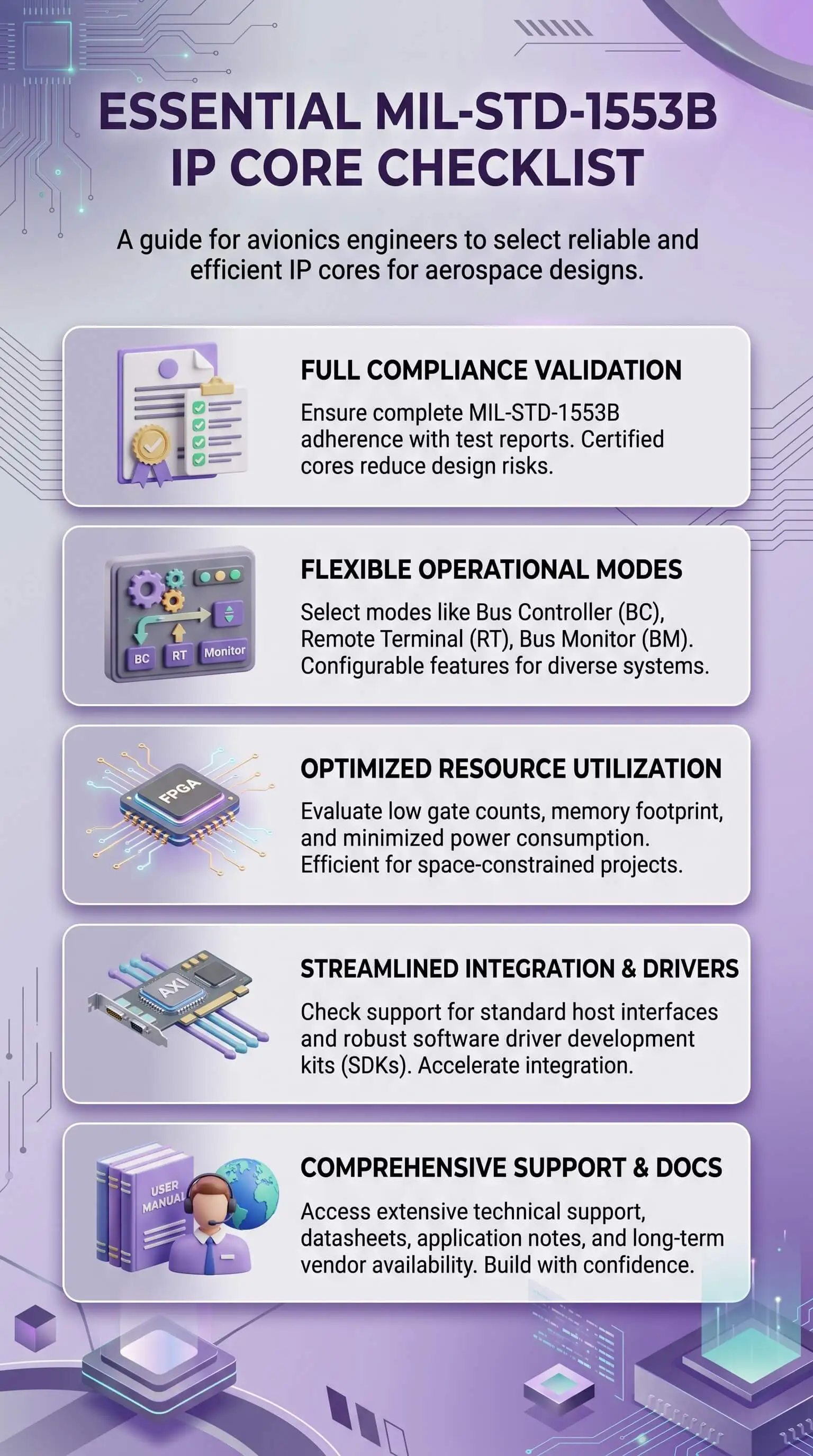
Put the Checklist to Work
Shortlist two or three cores and run each one through this checklist. Ask every supplier, in writing, for the RT validation report, the DO-254 artifact list, the FPGA families they've already targeted, and how their core works with MIL-STD-1553 transformers in the final hardware design. The hour you spend scoring candidates now is the schedule you keep later.