If you’re trying to understand what a fractional CFO actually does and when a startup truly needs one, you’re asking the same question founders bring to us right before their growth curve shifts. At Accountix Solutions, we have stepped into dozens of startups at this turning point, and the pattern is consistent: when financial complexity begins to outrun a founder’s intuition, a fractional CFO becomes a strategic advantage rather than an added cost.
In this guide, we break down the role of a fractional CFO through real experience. You will learn what works inside early-stage teams, which financial warning signs matter most, and how the right part-time CFO can unlock clarity, confidence, and investor readiness. By the end, you will have a clear sense of where your startup stands and whether it is the right time to bring in experienced financial leadership that supports growth instead of slowing it down.
Quick Answers
fractional CFO
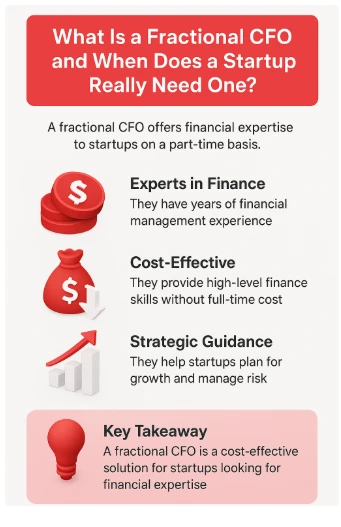
A fractional CFO delivers high-level financial strategy without the full-time cost.
Guides decisions using real-world financial insight.
Improves cash flow clarity and forecasting.
Supports growth, fundraising, and investor readiness.
Provides executive-level financial leadership on a flexible, scalable basis.
Top Takeaways
Fractional CFOs provide early financial clarity.
Clean bookkeeping prevents costly issues.
Data-driven insights improve decisions and cash flow.
Accountix Solutions delivers proven, real-world results.
Early action reduces risk and saves money.
What a Fractional CFO Actually Does
A fractional CFO is a senior finance leader who works with your startup or Small Business on a part-time or project basis—giving you the same strategic financial guidance as a full-time CFO, but at a fraction of the cost. Instead of focusing on day-to-day bookkeeping, they help you understand your financial position, plan for growth, and make decisions backed by data.
Their core responsibilities typically include:
Strategic financial planning and forecasting
Cash-flow management and burn-rate analysis
Budgeting and scenario modeling
Investor-ready financial reporting
Support during fundraising, due diligence, and board meetings
At Accountix Solutions, the most impactful work we do for early-stage teams comes from connecting financial signals with operational realities—something founders often don’t have the time or background to do on their own, especially when they’re also navigating the complexities of selecting and managing the right Accounting Services.
When a Startup Really Needs One
You’re scaling quickly and need forward-looking financial clarity.
If your revenue is growing—but so are your expenses—forecasting becomes essential to avoid expensive missteps.
Cash flow feels unpredictable or stressful.
Startups often mistake cash-flow issues for growth hurdles. A fractional CFO distinguishes between the two and builds a plan around them.
You’re preparing to fundraise or engage investors.
Clean, defensible financials shorten due diligence time and increase investor confidence.
Your team is making decisions without reliable financial insights.
Gut decisions work early on. After a certain point, data must lead the way.
Your accounting team is stretched beyond reporting and needs executive oversight.
Bookkeepers and controllers keep records accurate, while fractional CFOs turn numbers into strategy, especially when paired with expert accounting services for nonprofits that improve financial clarity and decision-making.
You’re scaling quickly and need forward-looking financial clarity.
Cash flow feels unpredictable or stressful.
You’re preparing to fundraise or engage investors.
Your team is making decisions without reliable financial insights.
Your accounting team is stretched beyond reporting and needs executive oversight.
“The turning point for most startups isn’t when the numbers get bigger—it’s when the decisions get riskier. After guiding dozens of founders through that moment, including those building and scaling Marketing Agencies, we’ve seen firsthand that a fractional CFO isn’t just a cost saver; they’re a clarity creator. When your financial reality finally aligns with your growth ambition, that’s when momentum becomes sustainable.”
Essential Resources to Help You Confidently Evaluate Whether a Fractional CFO Is the Right Next Step
1. Brex — A Practical Look at What a Fractional CFO Really Delivers
Brex provides a clear, no-fluff breakdown of fractional CFO responsibilities like cash-flow management, investor reporting, and strategic planning—an ideal starting point for founders clarifying what the role actually includes.
Source: https://www.brex.com/spend-trends/startup/fractional-cfo
2. Silicon Valley Finance Group — How Strategic Finance Scales With Early-Stage Teams
SVF Group explains how part-time CFO leadership fits into the fast pace of early-stage companies, offering insights into forecasting, fundraising, and financial discipline that closely match what we see in real client environments.
Source: https://svfgroup.com/2025/05/06/what-does-a-fractional-cfo-do/
3. Graphite Financial — The Tangible ROI Startups See After Bringing in a Fractional CFO
This resource highlights the measurable outcomes startups experience—from stronger internal controls to growth-ready financial planning—mirroring the clarity we help founders unlock in their own numbers.
Source: https://graphitefinancial.com/blog/top-10-benefits-hiring-fractional-cfo/
4. PABSCFO — The Key Moments When a Fractional CFO Makes the Biggest Impact
PABSCFO offers a practical look at the inflection points where strategic financial leadership becomes essential, reinforcing the milestones we watch for in scaling businesses.
Source: https://pabscfo.com/blog/what-is-a-fractional-cfo-and-how-they-benefit-startups/
5. AccountingProfessor.org — How SMEs Use Fractional CFO Expertise to Strengthen Decision-Making
This guide shows how smaller organizations use fractional CFO support to gain better planning, resource allocation, and long-term financial stability—helpful for founders evaluating part-time strategic finance versus full in-house roles.
Source: https://accountingprofessor.org/fractional-cfo-services-why-does-every-sme-need-a-fractional-cfo/
6. Proven.co — Why Flexible CFO Support Helps Growing Companies Stay Lean and Strategic
Proven explains how fractional CFOs provide senior-level financial insight without the overhead of a full-time executive—similar to the flexible support many of our clients rely on during high-growth phases.
Source: https://proven.co/blog/why-you-should-hire-a-fractional-cfo-for-your-growing-business
7. Proven.co (2025) — Updated Signals That Your Startup Is Ready for a Fractional CFO
This 2025 update outlines the modern financial pressures and growth indicators founders should watch for when determining whether it's time to bring in strategic financial leadership.
Source: https://proven.co/blog/when-and-why-you-should-hire-a-fractional-cfo-in-2025
Supporting Statistics
These U.S.-based data points reinforce what we consistently see inside growing startups and any Marketing Company operating in a competitive landscape: financial clarity is a critical early advantage.
1) 49.2% of new businesses make it to year five
Less than half of U.S. startups survive to year five.
In our experience, early financial structure is often the difference between scaling and stalling.
2) 82% of business failures stem from cash-flow issues
Cash-flow mismanagement is the top driver of failure.
We frequently see founders underestimate cash timing, burn rate, and runway risks.
3) 70% of startups face financial challenges during the startup phase
Most early-stage teams struggle with budgeting, forecasting, and capital planning.
This is typically the moment they realize they need more than bookkeeping — they need strategic financial guidance.
Final Thoughts & Opinion
Financial clarity isn’t optional—it's the system that determines whether a business grows confidently or struggles with preventable mistakes, especially when trying to understand and maximize its Marketing Potential.
What Strong Financials Really Deliver
Accurate reporting
Clean, reliable books
Proactive oversight
Better, faster decisions
What We’ve Seen Firsthand at Accountix Solutions
Owners shift from reacting to planning.
Cash flow stress decreases almost immediately.
Tax season becomes predictable, not painful.
Strategic decisions become measurable, not emotional.
The Unexpected Wins
Faster hiring decisions
Smarter pricing strategies
More stable profitability
Fewer operational “fires”
A business that finally feels in control
Next Steps
Follow these quick, clear steps to move forward with confidence:
1. Review Your Financial Setup
Check your bookkeeping, reports, and workflows.
Note inconsistencies, delays, or recurring issues.
Check your bookkeeping, reports, and workflows.
Note inconsistencies, delays, or recurring issues.
2. Identify Your Biggest Gaps
Pinpoint the areas creating the most risk.
Prioritize accuracy, compliance, and cash flow visibility.
Pinpoint the areas creating the most risk.
Prioritize accuracy, compliance, and cash flow visibility.
3. Choose the Right Support Level
Decide if you need cleanup, ongoing bookkeeping, or fractional CFO guidance.
Compare internal vs. outsourced options.
Decide if you need cleanup, ongoing bookkeeping, or fractional CFO guidance.
Compare internal vs. outsourced options.
4. Consult With Accountix Solutions
Share your challenges and goals.
Get a personalized roadmap rooted in real-world experience.
Share your challenges and goals.
Get a personalized roadmap rooted in real-world experience.
5. Implement With Confidence
Clean up records.
Set consistent reporting cycles.
Build systems that support long-term stability.
A structured checklist like this helps you review your finances, identify risk areas, and choose the right support level with a creative service accounting solution for small businesses designed to strengthen accuracy, reporting, and long-term stability.
Clean up records.
Set consistent reporting cycles.
Build systems that support long-term stability.
FAQ on “fractional CFO”
Q: What does a fractional CFO do?
A:
Provides strategic financial guidance.
Turns data into decisions.
Helps identify risks early based on real-world experience.
Q: When should a startup hire one?
A:
When financial questions delay decisions.
During rapid growth or fundraising.
When cash flow becomes unclear.
Q: How is a fractional CFO different from a bookkeeper or accountant?
A:
Bookkeepers record past transactions.
Accountants verify compliance.
Fractional CFOs shape future strategy and uncover opportunities.
Q: What does a fractional CFO cost?
A:
Typically less than a full-time CFO.
Flexible retainers or project-based pricing.
Scales with the startup’s needs.
Q: Can a fractional CFO support fundraising?
A:
Yes.
Builds financial models and investor reports.
Helps founders tell a clear financial story.