Most families with significant wealth already have a CPA, an estate attorney, and an investment advisor, and most of those professionals do good work. The trouble starts when no one holds the full balance sheet. Integrated wealth management in a multi-family office solves that problem by putting one team in charge of how your investments, taxes, estate plan, trusts, family governance, philanthropy, and reporting work together as a single plan.
The gap shows up fastest when wealth changes shape. Picture a founder one week after she sells the agency she spent twenty years building. The proceeds have landed. Her CPA is modeling the tax bill, the trusts her attorney drafted years ago still sit unfunded, and her adult children want to know what happens next. Strong multi family office wealth management services start with that whole picture, not with the investment account.
TL;DR Quick Answers
multi family office wealth management services
Multi family office wealth management services give families with complex wealth one coordinated team that runs investments, tax, estate planning, trusts, governance, and philanthropy as a single plan. The model offers much of what a private family office provides, shared across several families.
Starts with the full balance sheet, not just the investment account.
Coordinates your CPA, attorney, and trustee rather than replacing them.
Assigns one accountable owner to every open planning item.
Fits families with $10 million or more and complexity across trusts, entities, or generations.
Proves its value during a business sale, an inheritance, or a generational transition.
Top Takeaways
Integrated wealth management means one team plans investments, tax, estate, trusts, governance, and philanthropy together.
Scope and accountability set it apart, far more than a long service menu.
A multi-family office works alongside your CPA and attorney rather than replacing them.
Its value shows most clearly around big events like a business sale.
Fit depends on complexity, not a single net worth number.
What "Integrated" Actually Means
Integration comes down to scope and accountability. A multi-family office looks at everything the family owns and owes, then makes sure every specialist advising on a piece of it works from the same plan.
For many households, traditional wealth management and its focus on the investment account is the right place to begin. That frame gets too narrow once trusts, operating entities, real estate, and a second or third generation enter the picture.
The key distinction is scope. A firm can list a dozen services and still leave the family to connect them, which is why integration requires one team to answer for how those services fit together.
The Areas an Integrated Multi-Family Office Connects
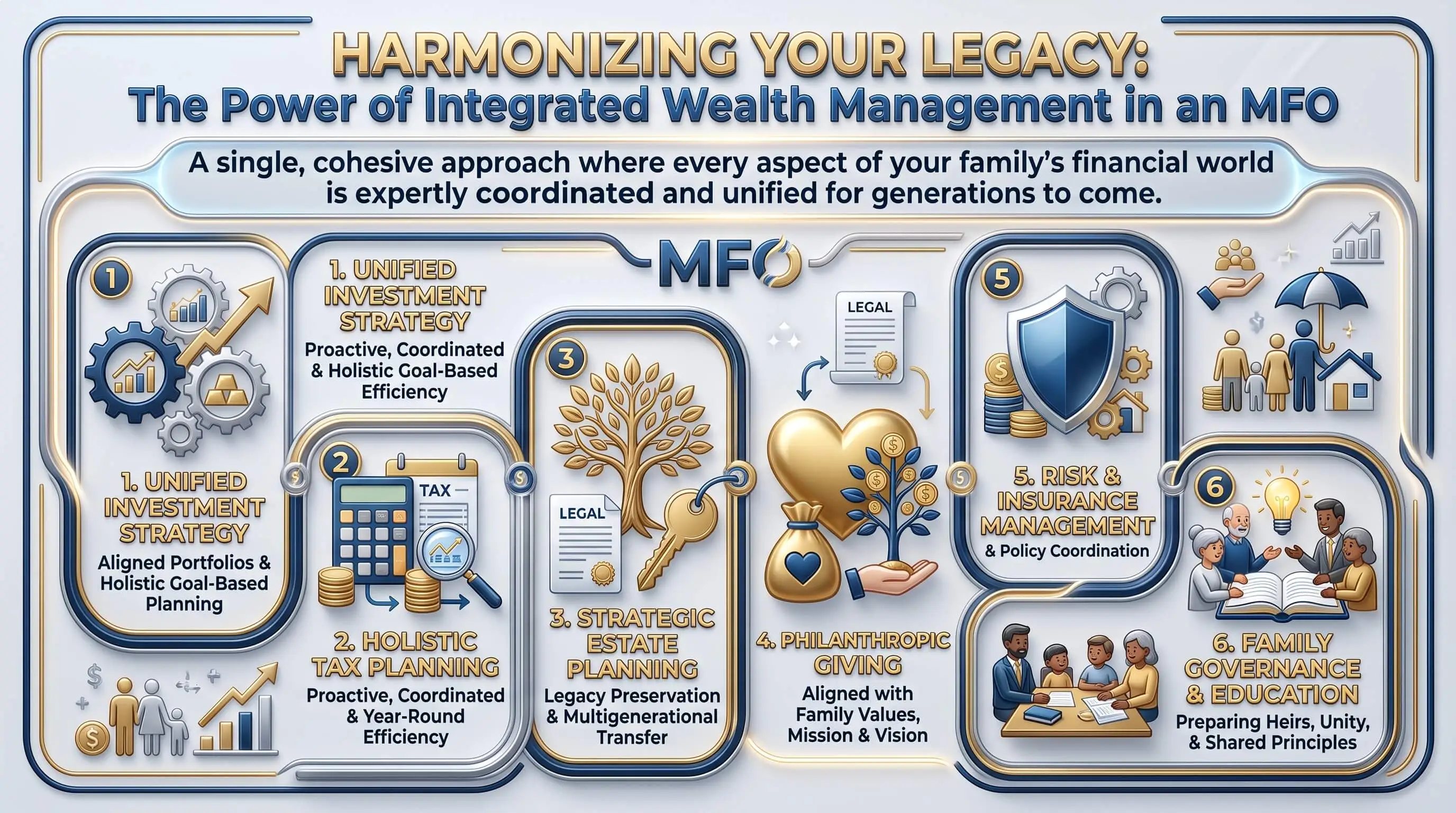
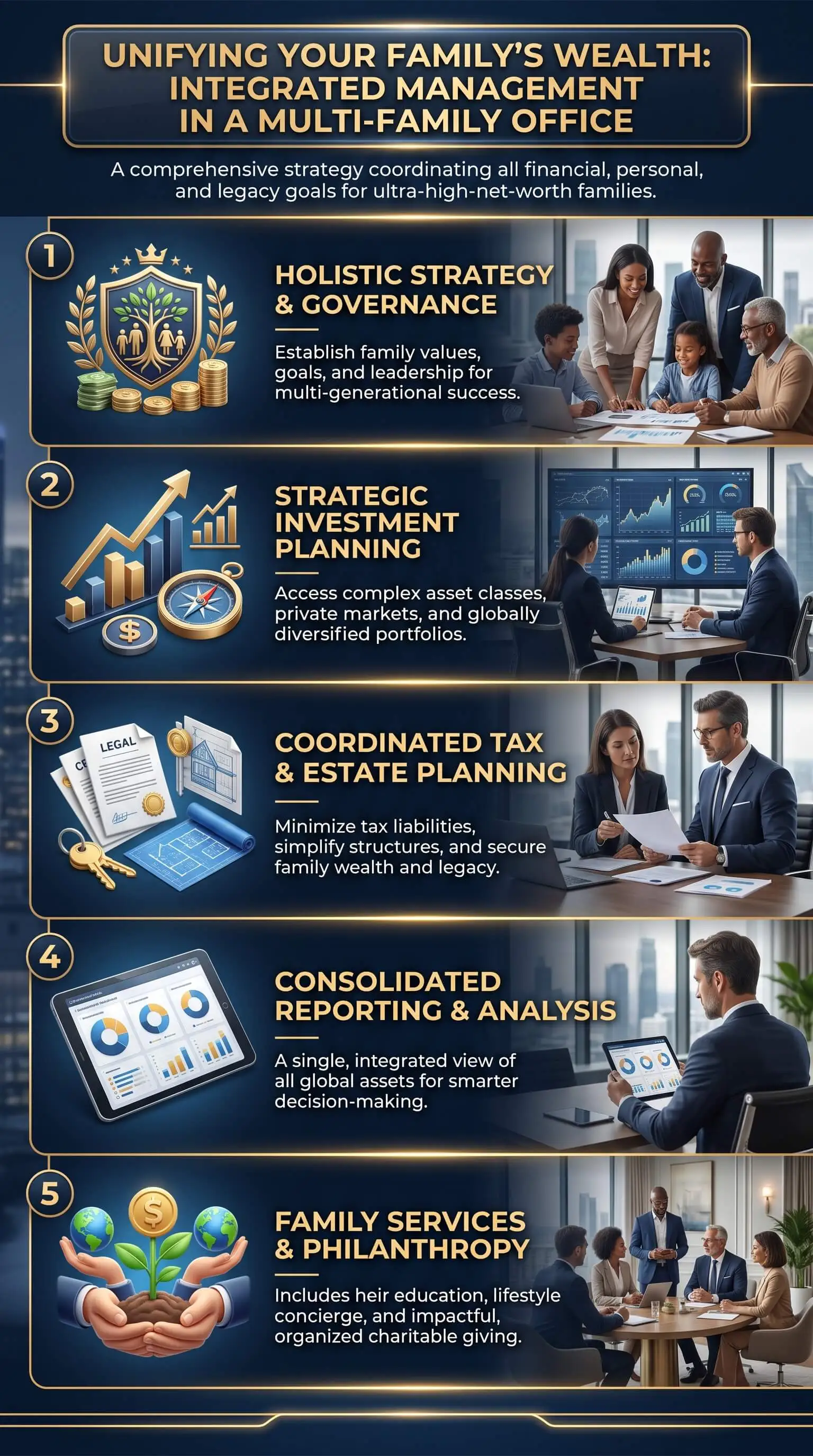
Investment oversight: asset allocation, liquidity, and risk across public markets, private investments, and real estate.
Tax coordination: keeping the tax picture visible with your CPA all year, not only in April.
Estate and trust coordination: confirming that titling, beneficiary designations, and trust funding match the plan on paper.
Personal CFO support: cash flow, liabilities, tax timing, and follow-through on major decisions.
Family governance and education: family meetings, decision frameworks, and preparing heirs before they inherit.
Philanthropy: donor-advised funds, foundations, and charitable trusts aligned with tax and estate goals.
Reporting and administration: one consolidated view across custodians, entities, and trusts.
Siloed vs. Integrated: One Decision, Two Outcomes
The difference is easiest to see in the decisions families actually face.
Selling a business: When advisors work separately, tax planning often begins after closing, once many options have narrowed. An integrated team sequences tax, trust, and gifting decisions before the sale.
Making a large charitable gift: Without coordination, the family usually gives from whichever account is most convenient. With it, the team decides which assets to give, when to give them, and through which vehicle.
Funding a trust: The family signs the trust documents, but no one retitles the assets. An integrated team tracks the funding until the trust holds what it was built to hold.
Holding a concentrated stock position: The investment advisor wants to diversify while the CPA worries about the tax bill. An integrated team puts both concerns on one page and builds a plan that answers them together.
An Illustrative Scenario: After the Sale
Consider an agency founder who, like many owners, relied on trusted accounting services for small businesses while she built the firm and is now selling to a larger holding company.
With an integrated team, the work starts months before closing. Her CPA models the tax impact of each deal structure under discussion. Her estate attorney reviews whether some shares should move into trusts first. The investment team sets aside liquidity for the tax bill and designs a plan for the rest, and the whole team gives a donor-advised fund serious consideration in a year of unusually high income. Her adult children hear, in plain terms, what changed and what it means for them.
No single advisor could carry all of that. The family should not have to serve as the messenger between specialists, and with one team keeping every piece moving in the same direction, it does not have to.
How Integration Works in Practice
The first 90 days should create clarity without burying the family in busywork.
Discovery: gathering statements, tax returns, estate documents, trust agreements, insurance policies, and entity records.
A consolidated balance sheet: one view of assets, liabilities, ownership, liquidity, and risk.
A planning gap review: sorting what is current, what is outdated, and what needs legal or tax review.
Advisor coordination: a named owner for each workstream.
An ongoing rhythm: regular meetings, updated reporting, and tracked deadlines well after the first 90 days.
Does an Integrated Multi-Family Office Replace Your CPA or Attorney?
No. Your CPA still prepares the returns, and your estate attorney still drafts the documents. The multi-family office keeps the full picture in view, confirms that their recommendations work together, and tracks each open item until someone closes it.
Who Benefits Most
Integration matters most for families with $10 million or more and real complexity across trusts, entities, business interests, and generations. Legacy Bridge Private Family Offices, an independent SEC-registered fiduciary based in West Des Moines, Iowa, works with families at that level and judges fit by complexity rather than a single threshold, with family office trust and business transition services supporting that broader coordination. Fee models vary by firm. Many charge a percentage of assets, while others use a flat retainer or a hybrid of the two.
"Most families who come to us already have good advisors. What they are missing is someone holding the whole picture. We have watched a well-drafted trust sit unfunded for years, and we have seen a smart tax move quietly undercut an estate plan, simply because no one connected the two. Integration is less about adding another specialist to the room and more about one team making sure every recommendation fits the life the family is actually living."
Essential Resources
We would hand these sources to any family weighing this decision.
1. Brown Brothers Harriman: Why Coordination Sits at the Center of the MFO Model
BBH explains how a multi-family office pairs shared infrastructure with advice tailored to one family, and it puts coordination at the center of the model.
Source: https://www.bbh.com/us/en/knowledge/what-is-a-multi-family-office.html
2. Family Office Exchange: What Integrated Wealth Planning Looks Like
Family Office Exchange frames integrated planning as testing every financial decision against the owner's whole situation, with tax, fiduciary, risk, and investment perspectives weighing in.
Source: https://familyoffice.com/navigating-wealth-management-landscape/integrated-solutions
3. Morgan Lewis: Choosing Between Single-Family, Multi-Family, and Outsourced Models
In this July 2026 analysis, Morgan Lewis compares family office structures and warns families against letting asset size, rather than complexity, drive the choice.
4. PWL Capital: A Plain-Language Look at Integrated Wealth Management
PWL Capital walks through how planning, investments, tax, estate, insurance, and giving should line up inside a multi-family office.
Source: https://pwlcapital.com/?p=110
5. Investor.gov: What to Ask Before Selecting an Investment Adviser
The SEC's investor education site covers what to ask before hiring an adviser, from services and fees to how the adviser gets paid and where conflicts can arise.
6. SEC Investment Adviser Public Disclosure: Verify Registration and Form ADV
Before you hand any firm the full picture, look up its registration and read its Form ADV, including any disciplinary history.
Source: https://adviserinfo.sec.gov/
7. IRS: How Donor-Advised Funds Work
The IRS explains how a sponsoring charity holds a donor-advised fund while the donor keeps advisory privileges, a structure that shows up often in coordinated giving plans.
Source: https://www.irs.gov/charities-non-profits/charitable-organizations/donor-advised-funds
These resources show how coordinated family office planning brings investment, tax, estate, fiduciary, philanthropy, and adviser oversight together, with outsourced family office executive services helping families manage that complexity through one integrated structure.
Statistics
More wealth is changing hands, and more of it needs coordination. The numbers below line up with what we see in our own client work.
1. $124 trillion is projected to change hands through 2048
Cerulli Associates projects $124 trillion in U.S. wealth transfers through 2048. More than half is expected to come from high-net-worth and ultra-high-net-worth households, which make up just 2% of all households.
Transfers that large touch estate documents, trusts, taxes, and heirs all at once. That is exactly where we see siloed advice start to fray.
2. Single-family offices are projected to reach 10,720 worldwide by 2030
Deloitte Private estimated 8,030 single-family offices worldwide in 2024, up from 6,130 in 2019, and projects 10,720 by 2030.
More families want family-office-level coordination. A multi-family office offers much of that capability without the cost of building a private office from scratch.
3. Only 39% of wealthy parents have given heirs guidance on their wealth
RBC Wealth Management surveyed 1,500 Americans with at least $1 million in investable assets in 2025. Among Baby Boomers, 89% said inheritance conversations matter, yet only 39% had actually given their heirs guidelines.
We see that gap often. Integration covers the human side of wealth too, through family meetings, their education, and a plan the whole family understands.
Final Thoughts & Opinion
Most families we meet have capable advisors, yet fragmented advice still leaves them with a decision-quality problem. When no one holds the full balance sheet, even excellent professionals make recommendations that pull in different directions.
Business owners tend to recognize this quickly. Plenty of them bring in fractional CFO support for a growing business because someone has to tie the numbers to the strategy. Integrated wealth management does that same job for the family, across investments, taxes, estate plans, trusts, and generations.
What Integration Delivers
A single, consolidated view of what the family owns and owes
Decisions made in context rather than in isolation
A named owner for every open item
Fewer surprises at tax time and during major transitions
What We See When It Works
Families stop serving as the messenger between their advisors.
Trusts hold what they were designed to hold.
Heirs understand the plan before they inherit it.
A business sale feels planned instead of rushed.
Advisors start talking to each other, not just to the family.
So the better question for most families is not whether their advisors are good, but whether anyone is making sure the advice fits together.
Q: What does integrated wealth management mean in a multi-family office?
A: One coordinated team manages investments, tax, estate planning, trusts, governance, philanthropy, and reporting as a single plan. The team weighs each decision against the family's full balance sheet, so advice from different specialists fits together.
Q: What multi family office wealth management services are usually included?
A: Most firms offer investment oversight, tax coordination, estate and trust coordination, Personal CFO support, family governance, heir education, philanthropic planning, and consolidated reporting. The exact mix depends on the firm and on what the family needs.
Q: How is integrated wealth management different from working with a financial advisor?
A: A financial advisor often focuses on investments and retirement planning. An integrated multi-family office starts with the full balance sheet and coordinates tax, estate, trust, governance, and philanthropic decisions around it.
Q: Does a multi-family office replace my CPA or estate attorney?
A: No. Your CPA and attorney keep their roles. The multi-family office works alongside them, keeps the whole picture in view, and tracks each item to completion so the family is not left connecting the pieces.
Q: Who needs integrated wealth management?
A: Families with significant wealth and complexity across trusts, entities, business interests, real estate, or several generations. A business sale, an inheritance, or a retirement transition is often the moment the need becomes obvious.
Q: How do multi-family offices charge for their services?
A: Fee models vary by firm. Many charge a percentage of assets under management, while others use a flat annual retainer or a hybrid. Ask any firm to put its services and fees in writing and to disclose its conflicts of interest.
Next Steps
If your family's wealth has outgrown a single advisor relationship, start by taking stock of what you already have.
List your current advisors. Write down every professional involved, from the investment manager and CPA to the estate attorney, trustee, and insurance advisor.
Map the decisions that fall between them. Note the choices that touch more than one discipline, such as a business sale, a trust, or a large gift.
Name the gaps. Look for unfunded trusts, outdated documents, or tax planning that starts too late.
Talk with a multi-family office. Ask how the firm coordinates outside advisors, who owns each workstream, and how the firm is paid.
Most families already receive plenty of advice, and what they need is that advice turned into one clear strategy, especially when outsourced business and financial accounting firms are part of the broader financial structure.
One call. One team. One coordinated strategy.