A founder in Iowa has a Letter of Intent on her desk, thirty years of work behind it, and two trusts her attorney drafted in 2019 that still hold nothing. Her daughter runs operations. Her son lives in Denver and has never seen the balance sheet. She has a buyer, a banker, and a closing date, but no plan for the Monday after the wire hits.
We meet some version of her often. Bankers and lawyers give the sale months of attention, while the question of who will carry the family's wealth, decisions, and values forward gets a few rushed weeks at the end. A family office succession planning checklist closes that gap by treating the exit and the family's future as one plan, with a name beside every task. That's the steady, coordinating work behind good family office services for business owners: one team holding the whole picture, so nothing waits until the options have narrowed.
Wealth rarely stays simple. In a liquidity event, the complexity multiplies quickly.
TL;DR Quick Answers
family office services
Family office services give a family one coordinated team for investments, tax, estate planning, trusts, governance, philanthropy, and financial administration. A family office works alongside the CPA and attorney you already trust, keeping the whole balance sheet in view so every decision fits a single plan.
What's included: investment oversight, tax and estate coordination, trust administration, family governance, heir preparation, philanthropy, and consolidated reporting.
How it works: one point of contact, often a Personal CFO, coordinates every advisor and tracks each open item until someone closes it.
Who it's for: business owners, executives, retirees, and multi-generational families whose wealth now spans entities, trusts, and several advisors.
When it matters most: before and after a business sale, an inheritance, or a generational handoff, when complexity multiplies fastest.
Your advisors stay: your CPA still files the returns and your attorney still drafts the documents, while the family office makes sure their advice works together.
Top Takeaways
Plan the business sale and the family's wealth succession as one effort.
Do the heavy lifting before a Letter of Intent, while your options are widest.
Fund your trusts, since an empty trust protects nothing.
Name the next leader of the family office and write down how the office keeps running without you.
Bring heirs in early so the plan isn't a surprise.
Use family office services to give every checklist item an owner while your existing advisors keep their roles.
Why Succession Planning Breaks Down for Business Owners
For most owners, the business is the biggest and least diversified thing the family owns. It also comes with a crowd: a CPA, an estate attorney, an investment advisor, an insurance agent, often a banker. Each one does good work on their own piece.
Succession touches every piece at the same time, though. A new valuation changes the estate plan, which changes how much you can give and when, which changes the tax bill at closing. When nobody connects those decisions, the family ends up carrying messages between specialists with a deadline attached. We've watched capable families lose months that way.
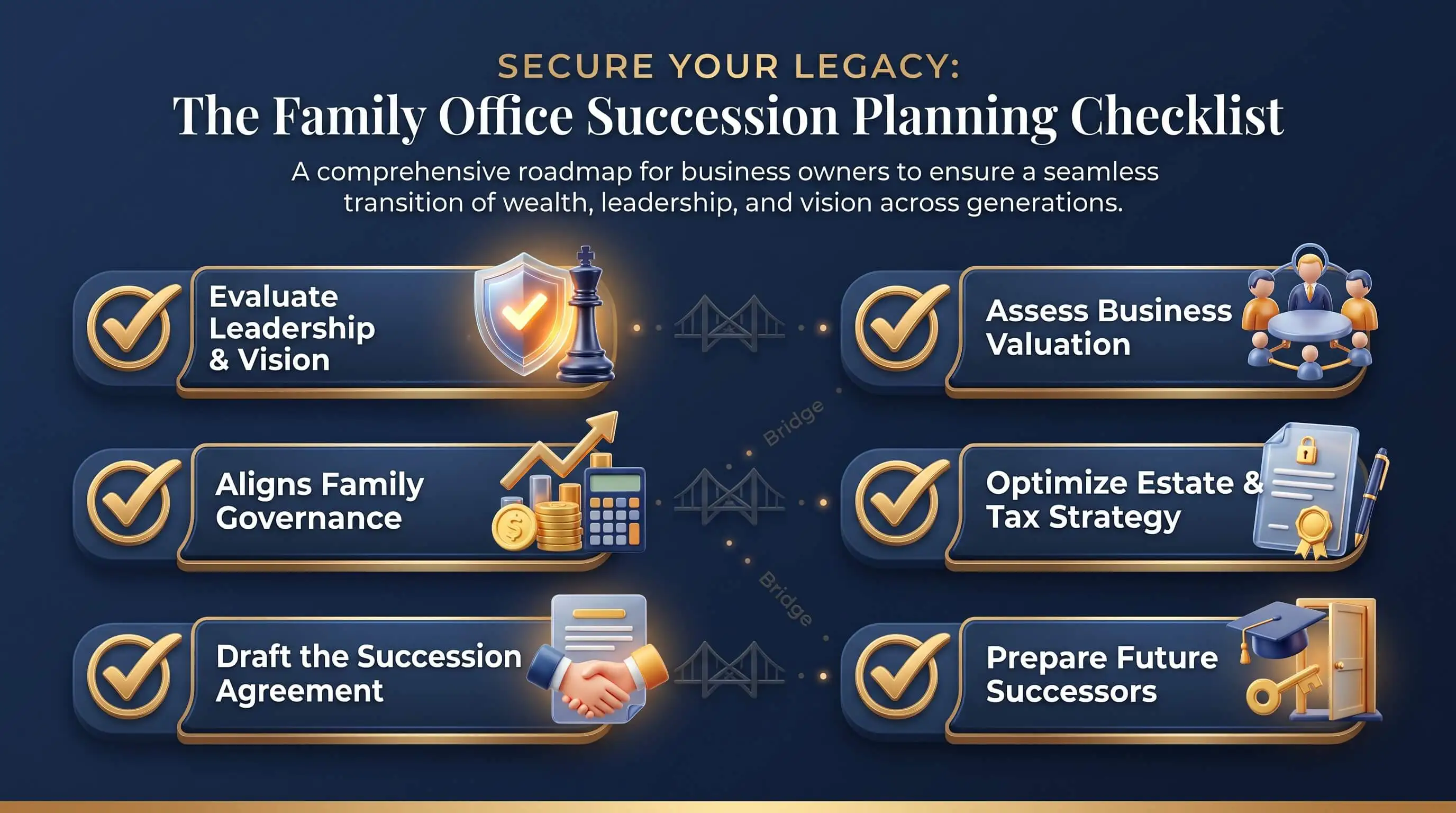
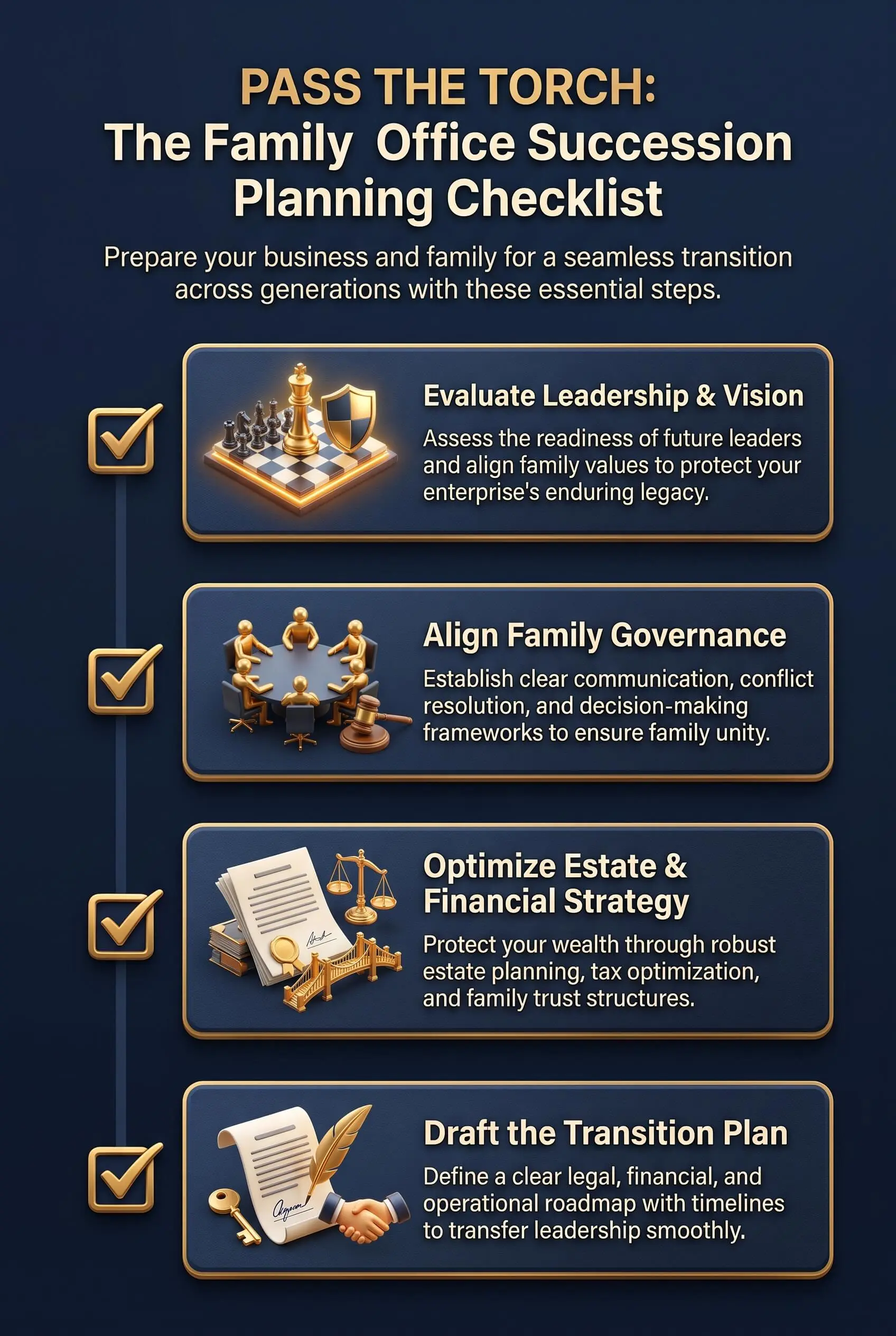
The Family Office Succession Planning Checklist
Twelve items, in roughly the order you'll need them. Some families won't need every one, but every family should know which one applies and who owns each, especially when using outsourced family office executive services.
Before the Sale: Use the Pre-Sale Window
The months before a Letter of Intent give you the most room to plan. Once terms are on paper, several of the best options get harder to use, and a few disappear.
Decide what you're actually passing on. The business, the wealth, leadership of the family office, or all of it? Write down the reasons behind your answer, because your children will accept a decision far more readily when they can see why you made it.
Put everything on one balance sheet. List accounts, entities, trusts, real estate, policies, and debts, then write each advisor's name beside what they handle. Most families find at least one gap the first time they do this.
Get a current valuation and look hard at your entity structure. A defensible number drives tax planning, gifting, and buy-sell terms. It's also the right moment to ask whether the way you own the company today fits the sale you want.
Revisit the buy-sell agreement and key person coverage. Terms written a decade ago can force a sale at the wrong price or to the wrong buyer. Check that any insurance funding still matches what the business is worth now.
Fund the trusts. A trust that holds nothing protects nothing. Retitle the assets, check every beneficiary designation, and confirm each trust holds what your attorney built it to hold, with Family office trust services helping coordinate the process.
Make gifting and trust moves before the LOI. For 2026, the federal estate and gift tax exemption is $15 million per person, the generation-skipping transfer exemption is also $15 million, and the annual gift exclusion is $19,000 per recipient. Moving shares into a trust before a signed deal sets their value can make a meaningful difference, and your CPA and estate attorney should weigh in on the specifics.
At the Sale: Turn Liquidity Into Structure
Closing changes the balance sheet overnight. An operating company becomes cash and securities, and the jobs the company used to handle, from cash flow to risk to reporting, land on the family.
Set aside the tax bill and build a liquidity plan before the wire hits. Decide how much stays liquid and how you'll invest the rest. In our experience, the first 90 days after a sale produce the most expensive rushed decisions a family makes.
Name who leads the family office next. Some families prepare a son or daughter. Others hire an outside executive or bring in a multi-family office. Pick a path, define the role, and put a date on the handoff.
After the Sale: Build Continuity
A sale closes one chapter of succession and opens the next, which usually runs for decades.
Write down how the family makes decisions. A family constitution, an investment committee, and a standing meeting calendar mean no single person has to carry every call.
Give heirs education and actual responsibility. Heirs who meet the plan for the first time at the reading of the will tend to resist it. Bring them into meetings early, and hand them roles that fit their age and interest.
Document the family office's own continuity plan. Who makes key decisions? Who covers each staff role, and how would someone reach accounts and records in an emergency? Families plan carefully for the business and then forget the office that now runs their wealth. We see this item skipped more than any other.
Review once a year, and after anything big. Births, deaths, marriages, divorces, moves, and new tax law can all change the right answer, so put the review on the calendar before you need it.
Where Family Office Services Fit in Your Succession Plan
Every item on that list needs an owner, and family office services provide one. A Personal CFO or family office team keeps the consolidated picture current, coordinates your CPA and attorney, and follows each open item through to done.
If you already have trusted advisors, that's a strength. Your CPA still prepares the returns and your attorney still drafts the documents. What changes is that one team takes responsibility for making their recommendations fit together, which is the idea behind integrated wealth management in a multi-family office. Owners who leaned on trusted accounting services for small businesses while building the company usually find the family balance sheet needs that same discipline.
Common Oversights That Put Family Wealth at Risk
The costly mistakes are rarely dramatic. Usually they're small items nobody owns.
Unfunded trusts. The family signed the documents, and nobody moved the assets.
No named successor for the family office. When the founder steps away, nobody has the authority or the context to keep things moving.
Stale beneficiary designations. Retirement accounts and life insurance pass outside the will, sometimes to an ex-spouse.
Tax planning that starts after the LOI. By then, the strongest gifting and trust strategies are harder to use.
Heirs kept in the dark. Surprise breeds conflict, and conflict drains family wealth faster than a bad market year.
"Nearly every owner who sits down with us has planned the sale. Far fewer have planned the Monday after it. We've watched families close a great deal and then spend a year untangling trusts nobody funded, gifts that came a few weeks too late, and grown kids who never learned how any of it works. Succession happens as a series of handoffs, and each one needs a name beside it. When the family office owns that list, the founder can finally step back while the family keeps its footing."
Essential Resources
We'd hand these to any family starting this work, and we return to several of them ourselves.
1. J.P. Morgan: A Family Succession Roadmap
A practical, five-stage worksheet that starts with an intergenerational steering committee and ends with a process for changing course when life rewrites the plan. It works well as the agenda for a first family meeting.
2. UBS: Where Family Offices Fall Short on Succession
UBS surveyed 307 family offices in 2026 and found that most still haven't written a succession plan for the office itself or built a structured way to prepare heirs. It's a useful reality check if you assume larger families have this solved.
3. J.P. Morgan Private Bank: The Risks Family Offices Rank Highest
This report ranks the risks 333 single-family offices see to their own continuity. Business-owning families put family conflict and missing succession plans near the top.
Source: https://privatebank.jpmorgan.com/nam/en/insights/reports/2026-family-office-report
4. Northern Trust: Questions to Ask Before a Leadership Handoff
Built from a survey of former family office CEOs, this short piece lays out the questions to settle before a leadership handoff, including whether to promote from within or hire from outside.
5. Bank of America Private Bank: Choosing Your Next Family Office Leader
A helpful guide for defining the skills and leadership style your family needs in its next family office leader, then planning the search, the role, and the pay.
6. Morgan Lewis: The 2026 Estate and Gift Tax Numbers
A clear rundown of the 2026 federal figures: the $15 million estate, gift, and generation-skipping exemptions, now permanent, and the $19,000 annual exclusion. Bring it to your next meeting with your CPA.
7. Exit Planning Institute: How Ready Owners Really Are
The Exit Planning Institute's owner-readiness research notes that only 20 to 30% of businesses taken to market actually sell. That figure alone makes the case for planning well before you list.
Source: https://exit-planning-institute.org/state-of-owner-readiness
Read together, these sources land where we do with clients. Succession holds up best when tax, estate, governance, and leadership decisions run through one coordinated plan, and that coordination is what family office services exist to provide.
Statistics
These numbers match what we see across the table from families every week. Most have planned carefully for their wealth, and far fewer have planned for who will steward it next.
1. Only 35% of family offices have a succession plan for the office itself
UBS's 2026 Global Family Office Report surveyed 307 family offices in more than 30 markets. Just 35% have a defined succession plan for the family office, and only 27% have a structured process to prepare heirs for future roles.
Families with dedicated staff and billions under management still leave the office's own continuity unwritten. It's item 11 on the checklist above, and it's the one we find missing most often.
2. 41% of business-owning families rank family conflict as a top-three risk
In J.P. Morgan Private Bank's 2026 Global Family Office Report, 41% of business-owning families named internal conflict and misalignment on strategy and values as a top-three risk, roughly double the rate of other families. Across all respondents, 33% put a missing succession plan for key decision makers in their top three.
Owning a business together brings more friction into succession. Written governance, a regular meeting rhythm, and early involvement from heirs give that friction somewhere to go before it turns into a dispute.
Source: https://privatebank.jpmorgan.com/nam/en/insights/reports/2026-family-office-report
3. 64% of family office CEOs expect a succession event within three to five years
Northern Trust surveyed former family office CEOs and, in 2022, reported that 64% expected a succession event within the next three to five years.
For most families, a leadership change at the family office is closer than it feels. Naming and preparing the next leader belongs on this year's calendar.
These statistics highlight a critical gap in family office succession planning: many wealthy families have carefully managed their assets but lack clear plans for leadership transitions, preparing heirs, and resolving family conflicts. For families that own B2B companies, establishing written governance, defining leadership responsibilities, and preparing the next generation are essential to protecting both business continuity and long-term family wealth.
Final Thoughts & Opinion
Our view, after years of sitting with families through sales and transitions, is that succession breaks at the handoffs far more often than on paper. The documents are usually sound. What slips is the space between them: a trust nobody funded, a gift made one quarter too late, an heir who never had a seat at the table.
Business owners tend to recognize this quickly. Plenty of them brought in fractional CFO support as the company grew, because someone had to connect the numbers to the strategy. A family office does that same job for the family, through the sale, the estate plan, and the generations after.
We'd go a step further. If you're more than a year from a possible sale, the single most valuable move is to name one person or team accountable for the whole checklist, and to do it before you hire a banker.
What a Finished Plan Gives You
A current view of everything the family owns and owes
An owner for every checklist item
A clear answer on who leads the family office next
Gifting and trust decisions made inside the pre-sale window
A review date already on the calendar
What We See When It Works
Founders step back without the family losing its footing.
Heirs know the plan before they inherit it.
Advisors finally work from the same page.
The year after the sale feels planned instead of rushed.
Frequently Asked Questions
Q: What should a family office succession planning checklist include?
A: At minimum: one consolidated balance sheet, a current business valuation, an updated buy-sell agreement, funded trusts, gifting decisions made before the sale, a liquidity and tax plan, a named successor for the family office, written governance, a plan for preparing heirs, and a standing annual review.
Q: When should business owners start succession planning?
A: Two to three years before a sale is ideal, and it should always happen before you sign a Letter of Intent. Once deal terms are set, many tax, trust, and gifting strategies lose much of their value or become harder to use.
Q: What do family office services cover during a business succession?
A: Family office services coordinate the investment, tax, estate, trust, governance, and administrative work around a transition. A Personal CFO or family office team keeps the full picture current and checks that each advisor's recommendation fits the overall plan, while your CPA and attorney keep their roles.
Q: How is family office succession different from business succession?
A: Business succession settles who owns and runs the company. Family office succession settles who stewards the family's wealth, makes the key decisions, and leads the office that manages it all. Owners who sell usually face both, one right after the other.
Q: Who should lead a family office after the founder steps back?
A: That depends on the family. Some prepare a family member, some hire an outside executive, and others work with a multi-family office. Whichever route you take, name the person, define the role in writing, and plan the handoff on a timeline.
Q: How often should a family succession plan be reviewed?
A: Once a year at least, plus after any major event such as a birth, death, marriage, divorce, move, business sale, or change in tax law. Plans that go unreviewed slowly stop describing the family they were written for.
Next Steps
If a sale, a retirement, or a generational handoff is on your horizon, start with what you already have.
List every advisor. Write down your CPA, estate attorney, investment manager, insurance advisor, and trustee, along with what each one handles.
Circle the orphans. Go through the 12 checklist items and mark any that don't have a clear name beside them.
Pick a date before any LOI. Get the first planning conversation on the calendar while your options are still wide open.
Talk with a family office. Ask how the firm works with outside advisors, who owns each workstream, and how it's paid.
Your life is your legacy, and the plan that carries it forward deserves the same care you put into building it. We'd welcome the chance to talk it through in a private consultation.
One call. One team. Total clarity on what comes next.


